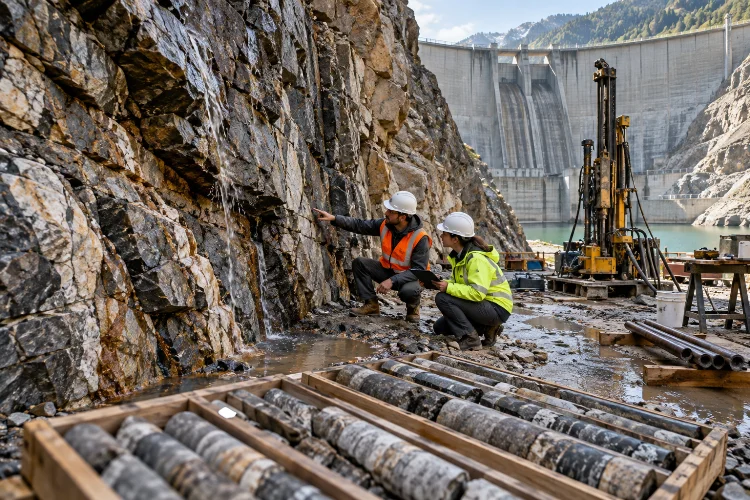
Imagine standing beside a massive concrete dam, watching millions of cubic meters of water held back by an enormous structure. Everything looks solid, stable, and almost impossible to move.
But what happens when the ground suddenly starts shaking?
Earthquakes introduce complicated forces that can challenge even the most carefully designed infrastructure.
For large concrete gravity dams, understanding these forces is especially important because structural damage could affect water storage, hydropower generation, and downstream communities.
This is where seismic performance evaluation of large concrete gravity dams becomes essential.
Rather than simply checking whether a dam can withstand a particular earthquake force, engineers investigate how the entire structure responds during and after seismic activity.
They examine stress concentrations, potential cracking, foundation movement, reservoir interactions, and possible failure mechanisms.
Modern evaluation techniques combine earthquake hazard assessments, structural dynamics, finite element modeling, and performance-based engineering principles.
The goal isn’t necessarily to guarantee that a dam experiences zero damage. Instead, it’s to understand its likely behavior, prevent catastrophic failure, and maintain an acceptable level of safety.
Let’s explore how these evaluations work and why they’re becoming increasingly important in modern dam engineering.
1. Understanding How Concrete Gravity Dams Respond to Earthquakes
Concrete gravity dams are designed to resist water pressure primarily through their enormous weight.
Unlike arch dams, which transfer significant loads toward their abutments, gravity dams rely heavily on their mass and foundation resistance to maintain stability.
Under ordinary operating conditions, engineers evaluate forces such as self-weight, hydrostatic pressure, uplift, and other environmental loads.
Earthquakes make this situation considerably more complicated.
The Role of Inertia and Dynamic Loading
When seismic waves reach a dam, the foundation moves and causes the structure to accelerate.
Because the dam has substantial mass, this movement generates inertia forces. These forces change throughout the earthquake as ground acceleration varies in magnitude and direction.
The response depends on factors such as structural geometry, concrete stiffness, foundation properties, damping, and the characteristics of the earthquake.
A tall concrete structure may also experience dynamic amplification when earthquake frequencies interact with its natural vibration modes.
Consequently, two earthquakes with similar peak ground acceleration can produce very different structural responses.
Why Massive Structures Can Still Develop Damage
Concrete performs well under compression but is much less resistant to tension.
During severe shaking, tensile stresses may develop near the upstream heel, downstream face, geometric transitions, or other vulnerable regions.
If those stresses exceed the material’s tensile capacity, cracking may occur.
Potential damage mechanisms include cracking through the dam body, sliding along construction joints, opening at the dam-foundation interface, and localized concrete crushing.
Foundation discontinuities can also influence stability.
This is why evaluating only the compressive strenght of concrete provides an incomplete picture of seismic safety.
Engineers must consider how the entire dam-reservoir-foundation system behaves during dynamic loading.
2. Identifying Earthquake Hazards and Seismic Design Requirements
Before running an advanced structural simulation, engineers need to understand the seismic environment surrounding the dam.
An earthquake hazard study provides the foundation for selecting realistic loading scenarios.
Without appropriate ground-motion information, even sophisticated numerical models can produce misleading predictions.
Seismic Hazard Assessment
Seismic hazard analysis examines potential earthquake sources, fault characteristics, regional seismicity, and local geological conditions.
Two widely used approaches are deterministic seismic hazard analysis and probabilistic seismic hazard analysis.
Deterministic analysis evaluates selected earthquake scenarios associated with relevant seismic sources.
Probabilistic analysis considers multiple possible earthquake events and estimates how frequently different levels of ground shaking may be exceeded.
Neither method automatically replaces the other. Many dam safety investigations use them together to understand credible hazards and associated uncertainties.
The Federal Guidelines for Dam Safety published through FEMA provide a framework for earthquake design and evaluation that includes ground-motion characterization and structural assessment.
Selecting Appropriate Design Earthquakes
Dam engineering commonly distinguishes between different earthquake performance levels.
An Operating Basis Earthquake (OBE) is generally associated with maintaining functionality or limiting damage under a specified level of shaking.
A Maximum Design Earthquake (MDE) represents a more severe seismic demand used to evaluate important safety objectives.
The exact definitions, hazard levels, and acceptance criteria depend on the applicable authority and project requirements.
For example, an engineer might investigate a ground-motion scenario with a peak ground acceleration of 0.25g.
Here, g represents gravitational acceleration, approximately 9.81 meters per second squared.
However, a peak acceleration value alone cannot describe the entire earthquake.
The frequency content, duration, vertical component, and time-dependent characteristics of shaking also influence structural behavior.
Why Local Geological Conditions Matter
Two dams located at similar distances from an earthquake source may experience different ground motions.
Local rock properties, fault geometry, topography, and wave propagation can influence the shaking reaching each foundation.
Near-fault ground motions may contain strong velocity pulses that create particularly demanding loading conditions.
Therefore, recorded or simulated earthquake accelerograms must be selected and processed carefully.
A reliable assessment should use ground motions consistent with the site’s seismic hazard and the performance objectives being evaluated.
3. Dam-Reservoir-Foundation Interaction: The Hidden Complexity
One of the biggest challenges in seismic dam analysis is that the concrete structure doesn’t respond independently.
The reservoir water and supporting foundation interact dynamically with the dam.
Ignoring these interactions can significantly alter predicted accelerations, displacements, stresses, and vibration characteristics.
How Reservoir Water Changes Seismic Response
When a concrete dam moves during an earthquake, it accelerates the surrounding reservoir water.
This generates additional hydrodynamic pressure against the upstream face.
Unlike ordinary hydrostatic pressure, which primarily depends on water depth, earthquake-induced hydrodynamic pressure changes with structural movement and ground shaking.
For perspective, freshwater at a depth of 100 meters produces approximately 0.98 megapascals of static hydrostatic pressure.
That’s a simple hydrostatic calculation, not an estimate of earthquake-induced pressure.
The actual seismic contribution depends on several additional factors.
Added Mass and Fluid-Structure Interaction
One traditional modeling approach represents reservoir effects through an equivalent added mass.
The Westergaard added-mass concept is commonly associated with simplified hydrodynamic analysis of gravity dams.
This method can be useful for preliminary investigations, but it doesn’t capture every aspect of reservoir behavior.
More advanced numerical models may represent reservoir water using acoustic fluid elements or other fluid-structure interaction formulations.
These approaches can account for effects such as water compressibility, reservoir geometry, and interaction with structural vibrations.
Research published in Infrastructures in 2024 compared different modeling approaches for the Koyna and Pine Flat dams, highlighting how model complexity and reservoir representation influence calculated seismic response.
Foundation Flexibility and Rock Interaction
Foundation rock also affects the dam’s dynamic behavior.
A perfectly rigid foundation is convenient for simplified calculations, but real geological materials deform under loading.
Rock stiffness, fractures, contact conditions, and energy radiation into the surrounding foundation can influence structural vibrations.
Engineers may represent these effects using foundation elements, equivalent springs, absorbing boundaries, or more advanced soil-structure interaction techniques.
The chosen approach should reflect the project’s seismic risk and available geological information.
Accurately representing these interactions often matters more than simply increasing the number of elements in the concrete model.
4. Numerical Methods for Seismic Performance Evaluation
Modern computational tools allow engineers to investigate earthquake behavior at a level of detail that traditional hand calculations cannot provide.
However, different numerical methods serve different purposes.
Understanding their limitations helps engineers select the appropriate analysis strategy.
Pseudo-Static Analysis
Pseudo-static analysis represents earthquake effects through simplified equivalent forces.
For example, horizontal inertia forces may be estimated using the dam’s weight and an assumed seismic coefficient.
This approach is relatively straightforward and can be useful for initial screening.
However, it cannot fully represent time-dependent structural vibrations, dynamic amplification, or detailed cracking behavior.
The U.S. Army Corps of Engineers recommends more advanced dynamic techniques where seismic performance requires detailed evaluation.
Response Spectrum Analysis
Response spectrum analysis considers how structural vibration modes respond to earthquake excitation.
Engineers first estimate the natural frequencies and mode shapes of the dam.
The model then uses a design response spectrum to estimate peak dynamic response quantities.
This method is computationally efficient for many linear-elastic investigations.
It can help identify critical stress regions and determine whether more detailed analysis is necessary.
However, conventional response spectrum analysis doesn’t directly provide a complete chronological record of structural behavior.
Time-History Dynamic Analysis
Time-history analysis calculates structural response throughout an earthquake acceleration record.
Instead of considering only estimated peak demands, engineers can examine how displacement, acceleration, stress, and reaction forces evolve over time.
For instance, a simulation lasting 30 seconds with a time increment of 0.005 seconds would contain approximately 6,000 calculation intervals.
This numerical example illustrates the temporal resolution involved, although actual time-step requirements depend on the chosen formulation.
Time-history analysis is particularly useful for studying sequential cracking, dynamic sliding, and changing contact conditions.
The USACE manual EM 1110-2-6051 provides technical guidance for linear-elastic time-history analysis of concrete hydraulic structures.
Nonlinear Finite Element Analysis
Linear models assume that stress and strain maintain a proportional relationship within the modeled material behavior.
That assumption becomes less realistic when concrete cracks, contact surfaces open, or sliding develops.
Nonlinear finite element analysis can represent some of these mechanisms more explicitly.
For example, concrete damage-plasticity models may describe stiffness degradation and nonlinear behavior under tension and compression.
Interface elements can also simulate opening, closing, and frictional movement along selected joints.
These techniques offer valuable insights, but they require appropriate constitutive parameters, numerical controls, and verification.
A highly detailed model isn’t automatically more accurate if its material properties are poorly understood.
5. Evaluating Structural Stability and Performance Criteria
Once the numerical simulations are complete, engineers must interpret what the results actually mean for dam safety.
A colorful stress distribution or displacement animation is only the beginning.
The real objective is to determine whether the dam satisfies the applicable performance requirements.
Sliding, Overturning, and Foundation Stability
Sliding resistance is a major consideration for concrete gravity dams.
Earthquake forces can increase horizontal demand while changing the normal force acting along potential sliding surfaces.
Engineers evaluate available shear resistance along the dam foundation, construction joints, and other relevant discontinuities.
Overturning behavior and loss of contact may also require investigation, particularly when tensile zones develop at the base.
However, simplified stability factors should not be treated as complete descriptions of nonlinear earthquake behavior.
The Federal Energy Regulatory Commission’s gravity dam guidelines address stability methods, cracked-base analysis, foundation conditions, and dynamic evaluation.
These considerations help engineers identify potential instability mechanisms under extreme loading.
Cracking and Residual Displacement
Not every crack means a dam is about to fail.
Some localized damage may be acceptable under severe seismic loading, depending on its extent, location, and consequences.
A more important question is whether cracking compromises structural stability, water retention, or post-earthquake functionality.
Similarly, engineers may examine residual displacement, meaning movement remaining after the earthquake ends.
Permanent sliding or joint opening may indicate that additional investigation or rehabilitation is necessary.
Performance-based engineering recognizes that acceptable damage levels depend on the earthquake scenario and the required safety objectives.
Performance-Based Safety Assessment
USACE manual EM 1110-2-6053 emphasizes evaluating concrete hydraulic structures according to intended seismic performance.
Rather than applying one universal acceptance criterion to every situation, engineers can consider objectives such as continued operation, repairable damage, and prevention of catastrophic collapse.
For example, a moderate earthquake may require little interruption to operations, while a much rarer event may allow significant damage provided the structure maintains an acceptable level of safety.
The specific criteria must be established through applicable regulations and qualified engineering judgment.
This approach creates a more meaningful connection between numerical predictions and real-world consequences.
6. Model Validation, Uncertainty, and Real-World Case Studies
Even when a simulation uses advanced software, engineers still need evidence that the results are trustworthy.
Large dams often have complex construction histories, variable concrete properties, and geological conditions that cannot be measured perfectly.
These uncertainties make verification and validation essential.
Using Monitoring Data to Improve Models
Instrumentation provides valuable information about how a dam behaves in service.
Accelerometers can record structural shaking, while displacement sensors, joint meters, piezometers, and other instruments monitor relevant structural or hydraulic conditions.
When earthquake observations are available, engineers can compare measured responses with numerical predictions.
Ambient vibration testing can also help estimate natural frequencies and dynamic characteristics under small-amplitude conditions.
These measurements can support model updating.
For example, an unexpectedly low measured natural frequency might prompt engineers to review assumptions about foundation stiffness, structural condition, or reservoir interaction.
However, matching a few measured frequencies doesn’t automatically validate predictions of severe nonlinear damage.
Lessons From the Koyna Dam
The Koyna Dam in India is frequently examined in earthquake engineering research.
The structure experienced a significant earthquake in 1967, making its seismic behavior an important subject for numerical studies.
Researchers have used the dam to investigate cracking, nonlinear concrete behavior, and reservoir interaction effects.
A 2018 study by Behshad and Shekari examined seismic performance involving penetrated cracks and fluid-structure interaction.
The authors found meaningful differences between some nonlinear response predictions and simplified added-mass representations.
Such studies demonstrate why modeling assumptions deserve careful attention.
They also highlight the value of comparing different numerical formulations instead of assuming that one simulation produces an unquestionably correct answer.
Sensitivity Analysis and Engineering Judgment
Uncertainty assessment investigates how model outputs change when uncertain inputs are varied.
Engineers might examine different foundation stiffness values, concrete tensile strengths, damping assumptions, or reservoir elevations.
If small parameter changes produce large differences in predicted cracking or displacement, the results may be particularly sensitive to those assumptions.
This information can guide further site investigation and material testing.
A sound calbration process should also avoid adjusting parameters merely to force agreement with selected observations.
Ultimately, seismic safety evaluation requires a combination of numerical evidence, field information, and experienced engineering judgment.
7. Building a Reliable Seismic Evaluation Workflow
Successful dam safety assessments usually follow a progressive process.
Starting with a complicated three-dimensional nonlinear model isn’t always the most efficient strategy.
A better approach is to begin with clearly defined engineering objectives and introduce additional complexity when the results justify it.
From Preliminary Screening to Advanced Simulation
The first stage involves reviewing existing dam information.
Engineers examine design drawings, construction records, geological reports, historical inspections, instrumentation data, and previous seismic studies.
Next, they establish appropriate earthquake scenarios and performance criteria.
Simplified stability calculations can help identify critical load combinations and potential weaknesses.
Linear dynamic models may then provide information about natural frequencies, stress distributions, and structural response.
If these investigations indicate significant uncertainty or possible damage mechanisms, nonlinear analysis may be warranted.
Importantly, each stage should provide useful information rather than merely serving as preparation for a more complicated model.
Improving Model Reliability
A dependable numerical workflow includes checks for mesh sensitivity, time-step adequacy, energy balance, and realistic boundary conditions.
Engineers should also verify that numerical results make physical sense.
For instance, unexpectedly large displacements might indicate a real instability mechanism, but they could also result from incorrect contact definitions or unrealistic foundation parameters.
These possibilities need to be investigated seperately.
Independent technical review is particularly valuable for high-consequence infrastructure.
Connecting Results to Dam Safety Decisions
The final evaluation should explain findings in terms that owners, operators, and regulators can use.
Instead of presenting only stress contours, engineers should identify important vulnerabilities, confidence levels, and potential consequences.
Possible recommendations may include additional monitoring, detailed foundation investigations, improved drainage, targeted structural rehabilitation, or further numerical analysis.
Any proposed modification should undergo its own engineering assessment before implementation.
The most effective seismic evaluation doesn’t simply produce a sophisticated computer model. It supports informed decisions that improve long-term dam safety and resilience.
Seismic performance evaluation plays a critical role in understanding how large concrete gravity dams behave during earthquakes.
From seismic hazard characterization and dam-reservoir interaction to nonlinear finite element analysis, modern engineering techniques provide valuable insights into structural stability and potential damage.
However, reliable assessments depend on more than powerful simulation software. Accurate material properties, realistic foundation conditions, appropriate earthquake records, and careful validation are equally important.
Performance-based evaluation helps engineers move beyond simple strength checks toward a clearer understanding of actual structural behavior and safety consequences.
As computational methods continue evolving, dam owners and engineering teams can make better-informed decisions about inspection, rehabilitation, and seismic risk reduction.
Planning a seismic safety assessment for a concrete gravity dam? Start by reviewing existing monitoring data, identifying critical failure mechanisms, and selecting an analysis approach that matches the structure’s risk level and engineering objectives.