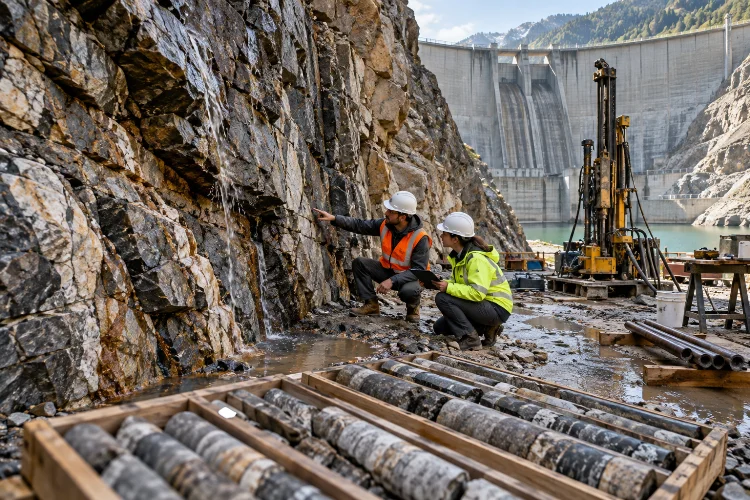
Imagine managing a massive dam that holds millions of cubic meters of water. Everything looks perfectly normal from the outside, inspections are completed regularly, and monitoring instruments show no immediate warning signs.
But here’s an important question: How confident can you really be that the dam will remain safe during an extreme flood, a powerful earthquake, or an unexpected structural problem?
Traditional engineering calculations can tell us whether a structure meets certain safety requirements. However, they don’t always explain how likely different failure scenarios are or what could happen if several unfavorable conditions occur together.
That’s where advanced dam safety assessment using probabilistic risk models changes the conversation.
Rather than treating safety as a simple pass-or-fail decision, probabilistic approaches evaluate uncertainty, failure likelihood, structural performance, and potential consequences.
This allows engineers to understand not only what might go wrong but also which risks deserve the most attention.
In this article, we’ll explore how modern probabilistic techniques work, why they matter for infrastructure safety, and how engineers can use them to make smarter decisions about inspections, maintenance, rehabilitation, and emergency preparedness.
1. Understanding Probabilistic Risk Assessment in Dam Engineering
Dam safety isn’t just about building strong structures. It’s about understanding how those structures might behave under conditions that aren’t completely predictable.
Rainfall intensity, earthquake magnitude, foundation properties, aging materials, and operational decisions all introduce uncertainty.
A probabilistic risk assessment, commonly called PRA, provides a structured way to examine these uncertainties.
Traditional Versus Risk-Based Safety Assessment
Traditional deterministic analysis generally evaluates a dam against specified loads and performance criteria.
For example, an engineer might calculate slope stability under a particular reservoir level or assess whether a spillway can safely accommodate a selected design flood.
These calculations remain essential.
However, they don’t necessarily reveal how frequently dangerous conditions might occur or how different failure mechanisms contribute to overall risk.
Probabilistic assessment extends the analysis by considering a range of possible loads, structural responses, and consequences.
The Federal Energy Regulatory Commission describes risk-informed decision-making as an approach that combines loading likelihood, system response, and failure consequences.
Importantly, this approach complements rather than replaces established engineering standards.
Understanding the Basic Risk Equation
The simplest expression of risk is:
Risk = Probability of an adverse event × Consequences of that event
For dam safety, engineers often examine the likelihood of a specific loading condition and the probability of failure under that condition.
A simplified relationship is:
Annual failure probability ≈ P(loading event) × P(failure given that loading event)
Suppose a hypothetical flood scenario has a 1% annual probability of occurring, and a dam has a 2% conditional probability of failure when subjected to that scenario.
The estimated annual failure probability associated with this particular pathway would be:
0.01 × 0.02 = 0.0002, or 0.02% per year.
That represents approximately a 1-in-5,000 annual probability for the modeled pathway, not a prediction that failure will occur once every 5,000 years.
Real assessments usually consider multiple loading ranges and failure mechanisms, while avoiding double-counting overlapping events.
2. Identifying Hazards and Collecting Reliable Engineering Data
Before building sophisticated probability models, engineers need to understand the dam itself.
Sounds obvious, right?
Surprisingly, incomplete historical documentation, uncertain subsurface conditions, and inconsistent monitoring records can become major obstacles in dam risk evaluation.
Evaluating Hydrological and Seismic Hazards
Flooding and earthquakes are two major external hazards considered in dam safety studies.
Probabilistic flood hazard analysis estimates the frequency of different flood magnitudes, including extreme events that may exceed the available historical record.
Engineers use rainfall observations, streamflow measurements, watershed characteristics, hydrological models, and statistical methods to develop flood hazard curves.
These curves connect flood characteristics with annual exceedance probabilities.
For example, a flood with a 0.1% annual exceedance probability has a 1-in-1,000 chance of being exceeded in any given year under the assumptions of the analysis.
However, an exceedance probability doesn’t mean that such a flood occurs on a predictable schedule.
Probabilistic seismic hazard analysis works similarly, estimating how frequently different levels of earthquake ground motion may affect the structure.
These estimates support evaluations of deformation, cracking, slope instability, and other earthquake-related responses.
Building a Dependable Data Foundation
A reliable assessment combines information from several engineering disciplines.
Geological investigations help characterize foundation materials and possible weaknesses, while geotechnical testing provides estimates of soil strength, permeability, and deformation behavior.
Structural records reveal how the dam was designed and constructed.
Meanwhile, piezometers, seepage measurements, deformation monitoring, and reservoir operating records can provide evidence of actual performance.
Historical inspection reports are especially valuable because they may reveal long-term trends that aren’t obvious from a single observation.
For example, gradually increasing seepage under comparable reservoir conditions could justify further investigation.
The Bureau of Reclamation’s guidance on probabilistic flood hazard analysis emphasizes matching analytical methods to project objectives and available data.
This is a critical lesson: more complicated models won’t automatically compensate for weak information.
3. Identifying Potential Failure Modes Before Calculating Risk
One of the biggest mistakes in quantitative risk assessment is jumping straight into probability calculations.
Before assigning numbers, engineers need a credible explanation of how a failure could develop.
This process is called Potential Failure Mode Analysis, or PFMA.
Common Dam Failure Mechanisms
Different dam types are vulnerable to different combinations of hazards and structural mechanisms.
For embankment dams, internal erosion may be particularly important.
Water can move through vulnerable areas in the embankment or foundation, potentially transporting soil particles and progressively enlarging seepage pathways.
Overtopping-related erosion is another important mechanism, especially when flood inflows exceed the available discharge capacity and reservoir storage.
Concrete dams may require detailed assessments of sliding, foundation instability, structural cracking, and other mechanisms associated with loading and material behavior.
The point isn’t to assume every possible failure is equally plausible.
It’s to identify credible mechanisms supported by site-specific evidence.
Developing a Failure Scenario
Consider a hypothetical earthfill dam with an uncertain foundation seepage pathway.
A potential failure scenario might involve elevated reservoir loading, increased seepage gradients, initiation of internal erosion, progressive soil transport, and eventual breach formation.
However, none of those transitions is guaranteed.
Internal erosion might begin without progressing to a complete breach because soil characteristics, filters, drainage features, and other factors influence the development of the mechanism.
Probabilistic modeling helps represent these uncertain transitions.
An experienced assessment team should include relevant specialists in geotechnical engineering, geology, hydrology, structural engineering, and dam operations.
This collaborative process improves the quality of engineering judgment and helps prevent important failure mechanisms from being overlooked.
4. Choosing Advanced Probabilistic Risk Modeling Techniques
Once credible hazards and failure pathways are established, the next challenge is choosing suitable mathematical tools.
Fortunately, engineers have several useful options.
Each technique serves a slightly different purpose, and combining methods can provide a more complete understanding of dam safety.
Event Tree Analysis
Event trees represent possible outcomes following an initiating event.
Imagine an extreme flood approaching a reservoir.
One branch might represent successful spillway operation, while another represents restricted discharge capacity.
Additional branches could represent different reservoir responses and potential failure outcomes.
Each branch is assigned a conditional probability based on available evidence and expert assessment.
Multiplying probabilities along a pathway provides the probability associated with that sequence, provided the conditional relationships have been defined correctly.
Event trees are particularly useful because they make the progression from initiating hazard to final outcome relatively easy to understand.
Fault Tree Analysis
Fault trees work in the opposite direction.
Instead of beginning with an initiating event, they begin with an unwanted system outcome and identify combinations of conditions that could contribute to it.
For example, a fault tree might examine how different equipment problems could combine to produce an unavailable gate-control function.
Logical relationships help engineers distinguish situations where several events must occur together from situations where a single event is sufficient.
However, statistical dependence and common-cause problems must be handled carefully.
Simply multiplying component failure probabilities without checking independence assumptions can produce misleading estimates.
Monte Carlo Simulation
Monte Carlo simulation is especially helpful when multiple uncertain parameters influence the result.
Instead of assigning one fixed value to every parameter, engineers use probability distributions representing plausible values.
A simulation repeatedly samples these distributions and recalculates the modeled outcome.
For example, a structural reliability assessment might consider uncertainty in soil strength, pore pressure, and material properties.
After thousands of simulations, engineers can estimate the distribution of performance outcomes.
The U.S. Army Corps of Engineers has developed quantitative risk calculation tools that use Monte Carlo methods to characterize uncertainty in dam and levee safety estimates.
Still, thousands of calculations cannot eliminate bias caused by inaccurate assumptions.
Bayesian Networks and Fragility Curves
Bayesian networks provide another useful approach by representing probabilistic dependencies among events and system conditions.
They can be particularly valuable when new monitoring information becomes available.
For instance, fresh instrumentation evidence may support an updated estimate of the likelihood of an underlying condition, provided the network and evidence model are appropriate.
Fragility curves serve a different purpose.
They describe the probability that a structure or component reaches a specified damage or performance state under different loading intensities.
A seismic fragility curve might estimate the probability of exceeding a deformation threshold as earthquake ground motion increases.
It’s worth remembering that exceeding a performance threshold isn’t necessarily the same as experiencing a complete dam breach.
These tools become most useful when they are connected to clearly defined physical mechanisms.
5. Managing Uncertainty and Improving Model Reliability
Probability models may look mathematically precise, but real-world engineering information rarely is.
That’s why uncertainty management deserves serious attention.
A probability estimate such as 0.0001 might appear highly specific, yet the evidence supporting it may be incomplete.
Aleatory and Epistemic Uncertainty
Engineers generally distinguish between two broad categories of uncertainty.
Aleatory uncertainty represents natural variability, such as the occurrence and intensity of floods or earthquakes.
Epistemic uncertainty comes from incomplete knowledge, including uncertain foundation properties, limited monitoring data, or imperfect numerical models.
The distinction matters because additional investigation may reduce knowledge uncertainty but cannot eliminate natural randomness.
For example, better laboratory testing might narrow uncertainty in a soil-strength parameter.
It won’t prevent extreme rainfall from occurring.
Sensitivity Analysis
Sensitivity analysis identifies which uncertain assumptions have the greatest influence on calculated risk.
Suppose an assessment includes uncertain values for foundation permeability, reservoir level, and erosion resistance.
By changing these parameters within credible ranges, engineers can examine how predicted failure probabilities respond.
If results are highly sensitive to erosion resistance, additional material testing or investigation may be more valuable than collecting unrelated measurements.
This is where probabilistic models become practical decision-support tools rather than complicated mathematical exercises.
Avoiding False Precision
An advanced model should communicate uncertainty rather than hide it.
Instead of presenting one failure probability without explanation, engineers can report central estimates, plausible ranges, confidence levels, and major assumptions.
They should also document limitations that cannot be readily quantified.
Probabilistic results depend on the quality of the input data, modeling assumptions, expert judgments, and relationships between variables.
Good tranparency helps reviewers understand why a particular risk estimate was produced.
Independent technical review is equally important, particularly for assessments supporting high-consequence infrastructure decisions.
6. Estimating Downstream Consequences with Risk Models
Knowing the probability of failure is only half the story.
A failure scenario involving a small remote reservoir can have very different consequences from one involving a large dam above a populated valley.
This is why consequence assessment plays such an important role in risk-informed dam safety management.
Dam Breach and Flood Inundation Modeling
Hydraulic models such as HEC-RAS can simulate hypothetical dam breach scenarios and downstream flood propagation.
Engineers evaluate possible breach dimensions, formation times, reservoir levels, and downstream hydraulic conditions.
These assumptions influence flood-wave arrival time, maximum inundation depth, and flow velocity.
The USACE HEC-RAS technical guidance specifically recommends sensitivity analysis because breach characteristics are often highly uncertain.
For example, two plausible breach formation times may produce significantly different peak discharges and warning periods.
Rather than relying on one assumed breach configuration, engineers should examine a credible range of scenarios.
Population at Risk and Life Safety
Flood consequence models also consider the population at risk, commonly abbreviated as PAR.
This includes people who may be present in potentially inundated areas.
However, population at risk isn’t the same as expected loss of life.
Actual consequences depend on factors such as flood severity, warning effectiveness, evacuation opportunities, exposure, and human response.
The Bureau of Reclamation’s Consequence Estimating Methodology considers flood depth, velocity, and available warning time when evaluating potential life loss.
As a simplified example, suppose a hypothetical failure pathway has an annual probability of 0.0002 and an estimated conditional mean consequence of 20 fatalities.
Its contribution to average annual life loss would be:
0.0002 × 20 = 0.004 expected fatalities per year.
This is a statistical risk measure, not a prediction of individual deaths in any specific year.
Engineers must also assess environmental damage, infrastructure disruption, economic consequences, and the effects of non-breach flooding.
A comprehensive assessment helps decision-makers understand both the likelihood and potential severity of different outcomes.
7. Turning Probabilistic Risk Results into Better Dam Safety Decisions
The purpose of probabilistic modeling isn’t simply to create more reports.
It’s to help dam owners, engineers, and regulators decide what actions will most effectively improve safety.
This is where risk-informed decision-making becomes especially valuable.
Prioritizing Safety Improvements
Imagine two hypothetical dams requiring attention.
Dam A has relatively frequent performance concerns but limited downstream exposure.
Dam B has a lower estimated probability of failure, yet a severe breach could threaten a much larger population.
A purely probability-based ranking may prioritize Dam A.
A consequence-focused ranking may prioritize Dam B.
A proper risk assessment considers both dimensions, together with uncertainty, urgency, legal obligations, and applicable safety requirements.
This prevents expensive maintenance decisions from being based only on inspection scores or isolated engineering indicators.
Evaluating Risk Reduction Measures
Probabilistic assessments can compare different improvement alternatives.
These may include strengthening structural components, improving seepage control, upgrading spillway capacity, revising reservoir operating procedures, or improving monitoring systems.
Some interventions primarily reduce the likelihood of failure.
Others, such as effective warnings and evacuation planning, may reduce consequences if an emergency develops.
For each alternative, engineers can estimate residual risk after implementation and compare it with the existing condition.
Economic considerations matter, but potential loss of life must receive appropriate priority.
Risk-informed decisions should also respect regulatory requirements rather than treating a favorable probability estimate as permission to ignore engineering standards.
Building a Continuous Safety Management Program
Risk assessment shouldn’t be treated as a one-time exercise.
Dams change as materials age, environmental conditions evolve, operating requirements shift, and new evidence becomes available.
Regular inspections, instrumentation reviews, and engineering investigations help keep risk estimates relevant.
For example, updated seepage monitoring may alter the interpretation of a previously identified failure mode.
Similarly, downstream population growth may increase potential consequences even if the physical condition of the dam remains unchanged.
A proactive maintenence program should therefore connect monitoring data with periodic risk reassessment.
Digital monitoring systems and automated data analysis may also improve the speed of detecting unusual performance patterns.
However, automated alerts still require sound engineering interpretation.
The strongest dam safety programs combine reliable technology, experienced professionals, clear responsibilities, independent review, and well-practiced emergency procedures.
Advanced dam safety assessment provides a more complete understanding of infrastructure risk by combining engineering analysis with probability, uncertainty, and consequence evaluation.
Instead of asking only whether a dam meets specified design criteria, probabilistic models help engineers explore how different hazards might develop into failure scenarios and which outcomes could be most serious.
Techniques such as event trees, Monte Carlo simulation, Bayesian networks, and flood inundation modeling support more informed safety decisions.
However, their effectiveness depends on reliable data, realistic assumptions, independent review, and experienced engineering judgment.
The real objective isn’t predicting failure with perfect accuracy. It’s reducing uncertainty where possible and making defensible decisions that protect communities and infrastructure.
Ready to strengthen your dam safety strategy? Start by reviewing potential failure modes, identifying critical data gaps, and evaluating how probabilistic risk analysis can improve your inspection priorities, risk reduction planning, and emergency preparedness.