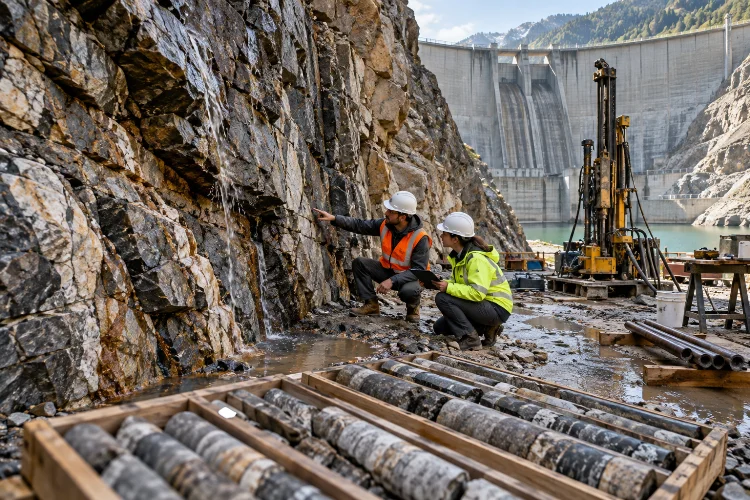
Imagine managing a massive dam that holds back millions of cubic meters of water. Everything appears normal from the outside, but deep within the structure, tiny movements, changing water pressures, or unusual seepage patterns could be developing.
The worrying part? These changes might remain unnoticed until they become serious.
Traditionally, dam safety has relied on periodic inspections, manual measurements, and engineering assessments. While these methods remain essential, modern infrastructure requires something more connected, responsive, and capable of identifying potential problems earlier.
That’s where integrated dam monitoring systems for structural risk prediction come into play.
By combining intelligent sensors, automated data collection, real-time analytics, and predictive models, engineers can better understand how dams respond to changing environmental and operational conditions.
Instead of simply reviewing what happened last month, monitoring teams can identify unusual trends as they emerge and investigate potential structural risks before they escalate.
In this article, we’ll explore how integrated monitoring works, which technologies make it possible, and how predictive analytics can support safer, smarter dam management.
1. Understanding Integrated Dam Monitoring Systems
Dam monitoring isn’t exactly a new concept.
Engineers have measured water pressure, structural movement, and seepage for decades. What’s changing is how these measurements are collected, connected, analyzed, and used to support safety decisions.
Modern dam safety monitoring combines multiple information sources into a coordinated framework.
From Individual Instruments to Connected Monitoring
Traditional instrumentation systems may operate independently.
One instrument measures internal water pressure, another tracks structural displacement, and a separate device records reservoir elevation. Engineers periodically collect readings and examine whether anything looks unusual.
An integrated platform brings these measurements together.
Instead of evaluating isolated numbers, operators can compare structural behavior with reservoir conditions, temperature, rainfall, and historical performance.
For example, small movements in a concrete dam may be expected when reservoir levels or temperatures change.
However, if displacement continues increasing while the hydraulic and thermal conditions remain relatively stable, the pattern may deserve closer investigation.
The real advantage comes from understanding relationships between measurements.
Why Structural Risk Prediction Matters
A monitoring instrument tells you what is happening at a particular location.
A predictive monitoring model attempts to estimate what could happen next based on historical behavior, current conditions, and engineering assumptions.
This distinction is important.
Structural risk prediction doesn’t mean knowing exactly when a dam might fail. It means identifying concerning trends, estimating likely responses, and supporting decisions about inspection, maintenance, or further investigation.
The U.S. Bureau of Reclamation emphasizes evaluating dam safety through loading conditions, structural response, and potential consequences.
Integrated monitoring provides evidence that can strengthen this risk-informed approach.
2. Essential Sensors for Modern Dam Safety Monitoring
A reliable monitoring system starts with the right instruments.
Different types of dams experience different engineering challenges, so sensor selection should reflect the structure’s design, foundation conditions, operating history, and potential failure mechanisms.
Simply installing more sensors doesn’t automatically improve safety.
Piezometers and Seepage Monitoring
Internal water pressure is particularly important for earthfill and rockfill dams.
Piezometers measure pore-water pressure or hydraulic head within embankments, foundations, and surrounding materials.
Unexpected pressure changes may indicate altered drainage conditions, elevated hydraulic gradients, or changes in seepage behavior.
Seepage monitoring devices, including weirs and flow-measurement systems, help engineers track water emerging through designated drainage paths.
For instance, an increase in seepage flow following a reservoir rise may be expected.
But increasing seepage under relatively stable conditions, especially when accompanied by cloudy water or transported sediment, could indicate an issue requiring urgent assessment.
Individual measurements must always be interpreted within their physical context.
Structural Displacement and Deformation Sensors
All dams experience some movement.
Concrete structures respond to temperature changes, reservoir loading, and other environmental influences. Embankment dams may experience settlement and deformation over time.
The goal is to distinguish expected movement from abnormal behavior.
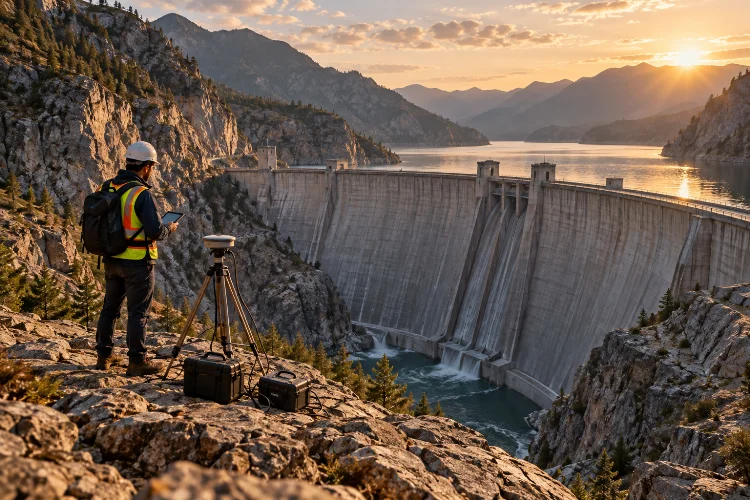
Common monitoring technologies include extensometers, inclinometers, joint meters, automated total stations, and Global Navigation Satellite System (GNSS) receivers.
These instruments measure different aspects of structural displacement and deformation.
For example, GNSS monitoring can provide repeated position measurements at selected points, while inclinometers help identify subsurface lateral movement.
Combining these observations gives engineers a more complete picture of structural behavior.
Temperature, Vibration, and Environmental Sensors
Temperature influences the expansion and contraction of concrete structures.
Similarly, seismic events may cause rapid changes in structural response.
Temperature sensors, accelerometers, rainfall gauges, and reservoir-level instruments provide context that helps explain the measurements recorded elsewhere.
Fiber-optic sensing technologies can also support distributed strain or temperature monitoring in suitable installations.
However, selecting instruments involves more than technical capability.
Accessibility, calibration requirements, durability, measurement uncertainty, and long-term maintenence costs must also be considered.
The best monitoring network is one that provides dependable information throughout the dam’s operating life.
3. Connecting Sensors Through Real-Time Monitoring Platforms
Collecting measurements is only the beginning.
To make monitoring information genuinely useful, engineers need a system that can transfer, organize, validate, and display data efficiently.
This is where connected monitoring architecture becomes essential.
How Automated Data Collection Works
A typical system connects field instruments to data loggers or remote acquisition units.
These devices collect readings at predetermined intervals and transmit information through communication networks.
Depending on the site, connectivity may involve fiber-optic cables, cellular networks, radio links, or satellite communication.
Measurements are then transferred to centralized databases or dedicated monitoring platforms.
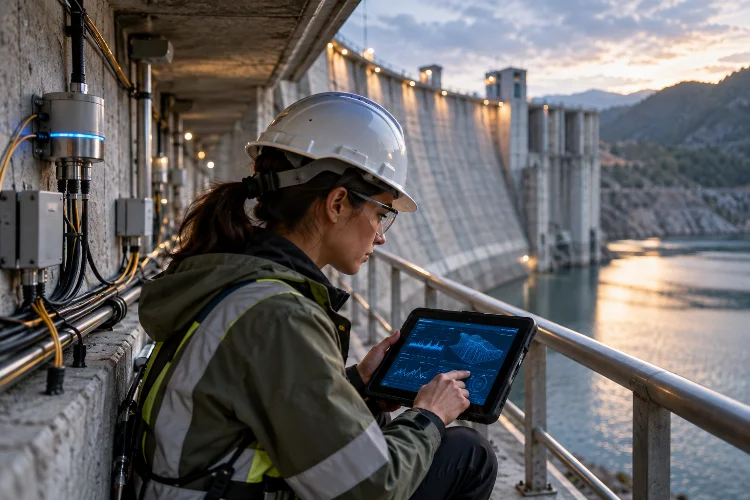
Operators can review trends, compare instruments, and identify unusual conditions through a common dashboard.
For example, a monitoring platform might display reservoir elevation alongside pore-pressure measurements and downstream seepage discharge.
Seeing these variables together helps engineers interpret relationships that would be less obvious when reviewing separate datasets.
The Importance of Data Quality
Here’s something that’s easy to overlook: collecting more information doesn’t necessarily mean obtaining better information.
Sensors can drift, communication systems can fail, and measurements may contain errors.
An apparent sudden increase in deformation might result from a damaged cable, incorrect calibration, or temporary data-transmission problem.
Automated quality-control procedures can flag missing measurements, unrealistic values, duplicated records, and abnormal changes.
Time synchronization also matters because measurements collected at different moments may produce misleading comparisons.
Reliable systems preserve original readings and maintain records of corrections, calibration, and sensor replacement.
These practices improve the reliablity of long-term structural performance analysis.
Cloud Platforms and Edge Computing
Cloud-based platforms can simplify centralized storage, visualization, and remote access.
However, remote dams may experience unreliable communication networks.
Edge computing provides an alternative by processing selected data near the monitoring instruments.
A local system can perform preliminary checks and preserve readings when communication with the central platform is interrupted.
For safety-critical applications, site-specific redundancy, cybersecurity measures, backup power, and clearly defined fail-safe procedures are essential.
A monitoring system should never depend entirely on uninterrupted internet access to support critical dam safety functions.
4. Using Predictive Analytics and AI to Identify Structural Risks
Now comes one of the most interesting developments in modern dam engineering.
Once monitoring systems collect reliable historical data, engineers can begin using statistical methods and machine learning to identify patterns that might otherwise remain hidden.
However, prediction requires more than feeding measurements into an algorithm.
Establishing Normal Structural Behavior
Before identifying abnormal behavior, engineers need to understand what normal looks like.
A concrete dam may move in response to reservoir pressure, temperature changes, and long-term material behavior.
Historical measurements can help establish relationships between these variables.
One established approach is hydrostatic-seasonal-time modeling, which uses water loading, seasonal influences, and time-related trends to estimate expected dam displacement.
Engineers can then compare actual measurements with predicted values.
If observations deviate significantly from expected behavior, further investigation may be necessary.
Importantly, a prediction error is not automatically evidence of structural damage.
It may also indicate unusual operating conditions, changing environmental influences, or weaknesses in the model.
Applying Machine Learning Models
Machine learning offers additional methods for analyzing complex monitoring datasets.
Algorithms such as random forests, support vector regression, and artificial neural networks can learn relationships between measured variables.
More advanced approaches, including long short-term memory networks, can be applied to sequential monitoring data.
For example, a model might examine several years of reservoir levels, temperature measurements, and structural displacement records.
It could then estimate expected deformation under a new combination of operating conditions.
A 2024 review published in Structures discusses the use of statistical, hybrid, and machine-learning models for concrete dam displacement monitoring.
The research also highlights challenges involving overfitting, causal interpretation, and the need to understand physical deformation mechanisms.
These limitations matter because a model that performs well on historical data may struggle when future conditions differ significantly.
From Anomaly Detection to Risk Assessment
Anomaly detection and structural risk assessment are related, but they aren’t identical.
An algorithm might identify an unusual increase in pore pressure. That observation alone doesn’t reveal the probability or consequences of dam failure.
A meaningful safety assessment also considers potential failure mechanisms, structural conditions, loading scenarios, and downstream exposure.
For example, a concerning pressure trend may lead engineers to investigate whether drainage performance has deteriorated or whether internal erosion is developing.
Risk-informed decision-making combines technical evidence with estimates of potential consequences.
AI should support qualified engineering judgment, not replace it.
Predictive outputs become more useful when models are validated, uncertainties are documented, and predictions can be explained in physical terms.
5. Developing Early Warning Systems and Risk-Based Alerts
Monitoring becomes especially valuable when information leads to timely action.
A dashboard showing hundreds of sensor readings may look impressive, but it provides limited protection if nobody knows what to do when conditions change.
Effective warning systems connect measurement thresholds with clear response procedures.
Establishing Meaningful Alert Thresholds
Alert limits should reflect expected structural behavior, instrument uncertainty, and the dam’s specific safety requirements.
Universal thresholds rarely work because dams differ in design, foundation conditions, materials, and operational characteristics.
For illustration, imagine an embankment dam where a piezometer normally records pressures between 20 and 28 kPa under a particular range of reservoir levels.
A reading of 31 kPa may deserve closer examination, especially if reservoir conditions haven’t changed.
However, those numbers are hypothetical and should never be treated as general safety limits.
Site-specific thresholds must be developed and reviewed by qualified engineers.
The Federal Energy Regulatory Commission (FERC) provides dam safety surveillance guidance that emphasizes defining threshold and action levels based on expected performance.
Creating Different Levels of Response
Not every unusual reading requires the same reaction.
A minor deviation might trigger additional data checks or increased monitoring frequency.
A more concerning trend could require an engineering inspection, independent measurements, or evaluation of operating conditions.
Conditions indicating a potential developing emergency must be handled according to the dam’s approved emergency procedures.
This distinction helps prevent both unnecessary alarm and dangerous complacency.
Connecting Alerts With Emergency Action Plans
An automated notification is not the same thing as an emergency warning to downstream communities.
Emergency Action Plans identify responsibilities, notification procedures, and coordinated actions for different emergency conditions.
Monitoring alerts should support those plans by providing timely and understandable information to the responsible decision-makers.
Operators also need clear procedures for equipment failure, communication loss, and contradictory measurements.
Regular exercises help confirm that staff understand how to respond when a genuine warning appears.
Technology can improve situational awareness, but effective emergency management still depends on people, training, and coordinated decision-making.
6. Implementing an Integrated Monitoring System: A Practical Example
Let’s explore how this works in a realistic engineering scenario.
Imagine a 75-meter-high embankment dam supplying water to a growing city.
The structure has operated for several decades, and its monitoring program includes manual piezometer readings, periodic settlement surveys, and routine visual inspections.
The owner now wants better visibility into changing conditions.
Step 1: Review Existing Safety Information
Before purchasing equipment, engineers review the dam’s design records, historical performance, previous inspection reports, and potential failure modes.
Suppose the assessment identifies changes in foundation pore pressure and downstream seepage as important monitoring priorities.
These findings guide instrumentation decisions.
Rather than installing sensors randomly, the team focuses on locations where additional information can improve understanding of structural performance.
Step 2: Upgrade Critical Monitoring Instruments
Selected piezometers are connected to automated data loggers.
Additional seepage measurements, reservoir-level sensors, and surface displacement monitoring points are introduced where justified.
Sampling frequency is selected according to how quickly meaningful changes could occur.
Slow settlement trends may not require the same reporting frequency as rapidly changing hydraulic conditions during an exceptional flood.
The equipment is tested, calibrated, and compared with existing manual measurements.
Step 3: Establish a Historical Baseline
The engineering team combines new measurements with available historical records.
They examine how pore pressure, seepage, and deformation respond to reservoir fluctuations and seasonal conditions.
A simple statistical model is introduced before attempting more sophisticated AI techniques.
This creates a reference against which future observations can be compared.
Step 4: Introduce Predictive Monitoring
Suppose the model predicts that pore pressure should remain relatively stable under current reservoir conditions.
Over several days, the measured pressure begins rising while seepage measurements also change.
The system flags these observations for engineering review.
The team verifies the instruments, examines weather and reservoir records, and performs a targeted field inspection.
The investigation determines whether the changes reflect normal variability, instrumentation problems, or a potential structural concern.
This hypothetical example illustrates the value of combining multiple data sources.
It does not suggest that monitoring software can independently diagnose internal erosion or guarantee advance warning of failure.
Step 5: Evaluate Performance and Improve the System
Following implementation, the owner reviews monitoring performance regularly.
Useful indicators include data completeness, sensor availability, time needed to investigate alerts, and the accuracy of predicted structural responses.
Models are updated when operating conditions or instrumentation changes.
Engineers also review whether the monitoring network continues to address the most important failure mechanisms.
The objective is continous improvement rather than simply installing new technology and leaving it unattended.
7. Future Innovations and Challenges in Dam Monitoring
Dam monitoring technology continues to evolve.
New developments are making it possible to observe infrastructure across larger areas and analyze increasingly complex datasets.
However, practical challenges remain.
Digital Twins and Physics-Based Modeling
A digital twin combines information about a physical asset with a digital representation that can be updated using operational data.
For dams, this may involve linking sensor measurements with hydraulic, structural, and geotechnical models.
Engineers can compare observed behavior with simulated responses under different reservoir conditions.
This approach may improve interpretation and scenario evaluation.
Still, a useful digital twin depends on accurate engineering assumptions, reliable data, and appropriate model validation.
Satellite-Based Deformation Monitoring
Interferometric Synthetic Aperture Radar (InSAR) uses radar observations to measure changes in surface position.
Under suitable conditions, it can detect small deformation patterns over extensive areas.
This makes it a potentially valuable supplement to ground-based surveying and structural instrumentation.
A 2022 review in Energy Geoscience discusses InSAR applications for monitoring hydropower infrastructure.
However, satellite measurements have limitations involving observation geometry, surface conditions, temporal coverage, and measurement uncertainty.
They should complement established monitoring methods rather than automatically replace them.
Managing Cost, Cybersecurity, and Long-Term Reliability
Modern monitoring systems can introduce challenges involving installation expenses, software integration, cybersecurity, and specialist training.
Organizations must also consider data ownership, equipment replacement, software updates, and long-term maintenance requirements.
Another challenge is the limited availability of real-world failure data for training predictive algorithms.
Because actual dam failures are relatively rare, machine-learning models may struggle to learn reliable warning patterns from historical examples alone.
Combining physical engineering knowledge with statistical analysis is therefore especially important.
Future progress will depend not only on smarter algorithms but also on dependable monitoring practices and transparent engineering decisions.
Integrated dam monitoring systems are changing how engineers evaluate infrastructure performance and identify potential structural concerns.
By connecting piezometers, displacement instruments, seepage measurements, and environmental sensors with centralized analytics, dam operators can develop a clearer understanding of structural behavior.
Predictive models add another valuable layer by highlighting unusual trends and supporting earlier investigation.
However, reliable dam safety management still requires physical inspections, validated engineering models, appropriate warning thresholds, and well-established emergency procedures.
The strongest monitoring strategy combines modern technology with experienced professional judgment.
Ready to modernize your dam safety approach? Start by reviewing existing instruments, identifying critical structural risks, and exploring opportunities to connect your monitoring data.
A carefully designed system can improve decision-making, strengthen operational preparedness, and support safer infrastructure over the long term.