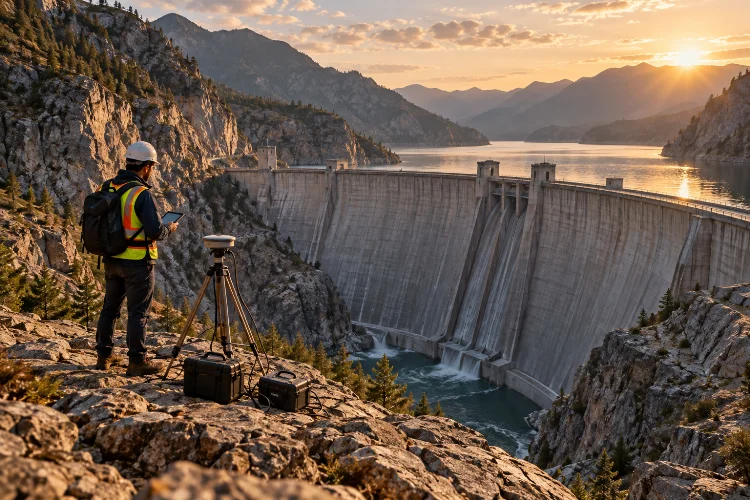
A dam might look like an incredibly strong structure from the outside, but its real stability depends on something most people never see: the ground underneath it.
Imagine constructing a massive water-retaining structure on what appears to be solid rock. Everything seems perfect until engineers discover hidden fractures, underground water pathways, or weak geological layers that could compromise the foundation.
Suddenly, the entire engineering project becomes much more complicated.
That’s why geotechnical risk assessment for complex dam foundation systems plays such an important role in modern dam engineering.
Rather than assuming the foundation will behave exactly as expected, engineers investigate potential weaknesses, analyze ground conditions, and evaluate how geological uncertainties might influence long-term structural performance.
These assessments combine field investigations, laboratory testing, groundwater studies, numerical simulations, and risk-based decision-making.
The objective isn’t simply to identify dangerous ground conditions. It’s to understand how those conditions could develop into serious problems and determine what can be done to prevent them.
Let’s explore how geotechnical risks are identified, analyzed, and managed throughout the life of a dam.
1. Why Complex Dam Foundations Require Detailed Risk Assessment
No two dam foundations are exactly alike.
One project might rest on strong granite, while another sits above fractured limestone, weathered rock, or deep alluvial deposits. Even within the same construction site, geological conditions can change dramatically over relatively short distances.
These variations make foundation engineering particularly challenging.
Understanding Geological Complexity
A seemingly solid rock formation may contain joints, faults, weathered zones, or weak bedding planes.
Some discontinuities remain relatively stable under normal conditions, while others may create pathways for groundwater movement or surfaces along which sliding could occur.
For example, a concrete gravity dam founded on layered sedimentary rock may encounter unfavorable bedding orientations.
If a weak geological plane dips downstream, it could influence the potential for sliding under certain hydraulic and structural loading conditions.
Meanwhile, an embankment dam constructed across a valley containing sand, gravel, and clay deposits may face different concerns.
These might include differential settlement, seepage, internal erosion, or earthquake-related deformation.
The key challenge is geological heterogenity: the fact that ground properties vary across the foundation.
Why Traditional Design Checks Aren’t Always Enough
Conventional geotechnical design often uses factors of safety to evaluate whether resistance exceeds the expected loading demand.
These calculations remain important, but they don’t necessarily describe every possible failure mechanism.
A foundation might satisfy a sliding stability criterion while still containing an unrecognized seepage pathway.
Similarly, acceptable settlement predictions may not reveal localized weak zones beneath critical infrastructure.
Risk-based assessment expands the evaluation by considering what could go wrong, how likely it is to happen, and what consequences might follow.
According to the Federal Energy Regulatory Commission (FERC), geotechnical investigations should focus on conditions that critically affect dam performance rather than collecting unnecessary information.
This makes understanding site-specific geological behavior a central part of effective dam safety engineering.
2. Investigating Foundation Conditions Before Problems Develop
Reliable risk evaluation begins with understanding the underground environment.
Unfortunately, engineers can’t simply look beneath an entire dam and observe every geological feature.
Instead, they must combine different investigation methods to construct a defensible interpretation of the subsurface.
Geological Mapping and Site Reconnaissance
The first step usually involves reviewing existing geological information.
Engineers examine regional geological maps, historical construction records, fault locations, groundwater conditions, and previous investigation reports.
Field reconnaissance helps identify exposed rock formations, fractures, landslides, springs, and other surface indicators.
For an existing dam, historical performance information can be especially valuable.
Unusual seepage patterns, changes in settlement, or earlier foundation repairs may reveal problems that aren’t immediately visible.
FERC’s geotechnical investigation guidelines emphasize using available project information before determining whether additional exploration is necessary.
Boreholes, Sampling, and In-Situ Testing
Subsurface exploration provides direct information about foundation materials.
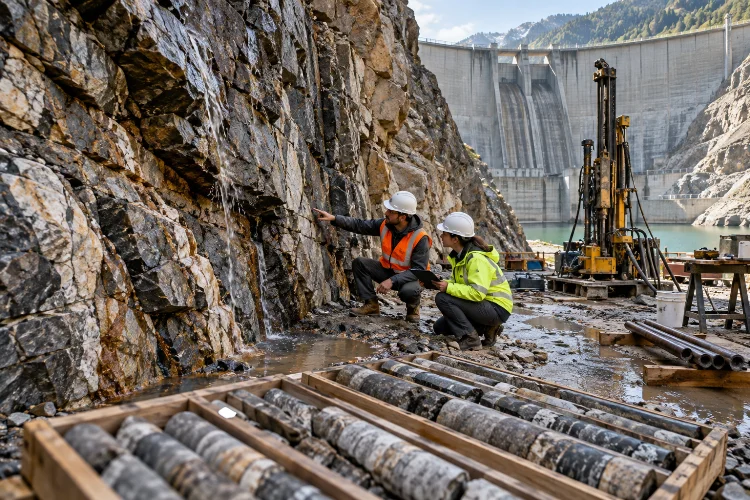
Boreholes allow engineers to recover soil samples and rock cores, examine geological layers, and investigate the location of important discontinuities.
Standard Penetration Tests (SPT) and Cone Penetration Tests (CPT) can provide information about soil characteristics, although their suitability depends on ground conditions.
Rock investigations may involve core logging, discontinuity measurements, and specialized strength testing.
Water-pressure testing can also help evaluate rock mass hydraulic conductivity.
For example, packer tests isolate selected borehole intervals to investigate water flow through fractures.
However, test results represent specific locations and conditions.
A few successful boreholes don’t guarantee that the surrounding rock mass is free from hidden weaknesses.
Combining Geophysics and Laboratory Analysis
Geophysical methods provide additional information between investigation points.
Seismic refraction, electrical resistivity tomography, and other techniques can help identify contrasts in material properties.
These methods are useful for developing geological interpretations, but their results are not always unique.
Engineers therefore combine geophysical observations with borehole information and laboratory measurements.
The U.S. Army Corps of Engineers’ geotechnical investigation guidance describes how exploration, testing, and geological interpretation support engineering design.
A well-designed investigation program reduces uncertainty while concentrating resources on the ground conditions that matter most.
3. Identifying Major Geotechnical Failure Mechanisms
Dam foundation risks rarely come from one isolated problem.
They often involve interactions between geology, groundwater, structural loading, and environmental conditions.
Understanding these mechanisms is essential for predicting how an apparently manageable weakness could develop into a serious safety concern.
Seepage and Internal Erosion
Water naturally moves through permeable soil and fractured rock when hydraulic gradients exist.
Some seepage is expected and can be safely controlled, but uncontrolled flow may create dangerous conditions.
In erodible materials, seepage can transport soil particles and progressively enlarge internal flow paths.
This process is commonly associated with internal erosion and piping.
The Federal Emergency Management Agency’s publication Evaluation and Monitoring of Seepage and Internal Erosion provides technical guidance for recognizing and investigating these hazards.
For example, a dam founded on sandy alluvium may experience increasing groundwater flow beneath its foundation.
If the material lacks adequate filtration or erosion protection, concentrated seepage could gradually remove particles from vulnerable areas.
The consequences depend on soil characteristics, hydraulic gradients, confinement, drainage conditions, and the continuity of potential erosion pathways.
Uplift Pressure and Sliding Instability
Seepage also influences foundation stability through pore-water pressure.
For concrete gravity dams, uplift pressure can reduce effective normal loading along the dam-foundation contact.
This may decrease available frictional resistance against sliding.
Engineers must therefore evaluate how reservoir levels, drainage performance, and foundation permeability influence uplift pressure distributions.
A grouting curtain may reduce water flow through selected foundation zones, while drainage systems can help relieve pressure.
However, drainage efficiency must be demonstrated rather than assumed.
An unexpected increase in uplift pressure may signal changing foundation conditions or reduced drainage performance.
Differential Settlement and Weak Geological Layers
Foundations containing materials with different stiffness characteristics may deform unevenly under loading.
This phenomenon is known as differential settlement.
Imagine an embankment dam extending across a valley where one portion rests on competent bedrock and another overlies compressible sediments.
As loading develops, the softer foundation materials may settle more than the adjacent rock-supported areas.
Excessive differential movement can contribute to cracking, distortion, or the development of preferential seepage pathways.
The actual response depends on the embankment design, foundation treatment, material behavior, and construction sequence.
Earthquakes and Foundation Liquefaction
Seismic loading introduces another layer of uncertainty.
Earthquake shaking can generate additional stresses, reduce soil strength, and cause permanent deformation.
Saturated, loose, contractive granular soils may be vulnerable to liquefaction under appropriate seismic loading conditions.
When liquefaction occurs, excess pore-water pressure can significantly reduce effective stress and available shear resistance.
Potential consequences include settlement, lateral spreading, and loss of foundation support.
Not every sandy foundation is susceptible, however.
A proper seismic assessment considers soil density, stress conditions, groundwater levels, grain characteristics, and site-specific earthquake demands.
4. Turning Geotechnical Hazards Into Meaningful Risk Estimates
Identifying a foundation weakness doesn’t automatically tell engineers how urgent the problem is.
A geological feature might be relatively common but unlikely to cause serious damage. Another condition may be less likely to occur yet carry much more severe consequences.
Risk assessment helps distinguish between these situations.
Potential Failure Mode Analysis
Potential Failure Mode Analysis (PFMA) examines the sequence of events that could produce an undesirable outcome.
Instead of merely stating that a foundation contains fractured rock, engineers investigate a more complete scenario.
For example, reservoir pressure might drive seepage through an existing discontinuity. If erodible material is present and appropriate controls are absent, progressive material loss could eventually affect structural stability.
This sequence provides a clearer basis for investigation, monitoring, and mitigation.
PFMA typically involves geotechnical engineers, engineering geologists, dam operators, and other relevant specialists.
The Bureau of Reclamation and U.S. Army Corps of Engineers describe potential failure mode analysis as an important part of risk-informed dam safety practice.
Probability, Consequences, and Uncertainty
Risk is commonly expressed conceptually as a combination of failure likelihood and consequences.
For dam safety, a more detailed framework considers loading-event likelihood, structural response conditional on that loading, and the resulting consequences.
Consider two hypothetical foundation scenarios.
One involves localized settlement that is unlikely to impair the dam’s essential functions. Another involves progressive internal erosion that could threaten reservoir containment.
Even if both require investigation, their potential consequences are very different.
Quantitative risk estimates can support prioritization, but they shouldn’t be interpreted as perfectly precise predictions.
Geological uncertainty, incomplete observations, and limitations in available failure data can influence the calculated results.
FERC’s risk-informed decision-making framework emphasizes using risk estimates alongside engineering standards and professional judgment.
5. Using Numerical Models to Evaluate Foundation Behavior
Modern numerical modeling allows engineers to investigate geological conditions that would be difficult to reproduce through physical testing alone.
These simulations can estimate how foundation materials respond to loading, groundwater movement, and changes in operating conditions.
However, their usefulness depends heavily on model assumptions.
Finite Element and Groundwater Flow Analysis
Finite Element Analysis (FEA) is widely used to investigate stresses, strains, and deformations in geotechnical systems.
Engineers divide the foundation into smaller computational elements and assign material properties based on geological investigations.
The model can then estimate settlement, stress redistribution, and potential deformation mechanisms.
For groundwater problems, seepage models calculate hydraulic head distributions, flow paths, and pressure conditions.
Consider a hypothetical foundation with a hydraulic head difference of 12 meters across a 30-meter flow distance.
The average hydraulic gradient along that assumed path would be approximately 0.4.
This simple calculation illustrates the relationship between head loss and flow distance, but actual dam foundations often require two-dimensional or three-dimensional seepage analysis.
Sensitivity Analysis and Probabilistic Modeling
One simulation rarely captures every realistic possibility.
Foundation strength, permeability, fracture connectivity, and stiffness may all be uncertain.
Engineers can explore these uncertainties by running models with alternative parameter values.
For example, a seepage model might compare several plausible hydraulic conductivity distributions.
A stability model could examine how the predicted factor of safety changes when the assumed shear strength along a critical discontinuity is reduced.
Probabilistic techniques, including Monte Carlo simulation, can extend this approach by evaluating many combinations of uncertain inputs.
The resulting distributions help reveal which assumptions most strongly influence predicted performance.
A particularly useful question is whether additional field data could materially change the engineering decision.
If improved information would significantly reduce decision uncertainty, targeted investigations may be worth the investment.
6. Reducing Geotechnical Risks Through Foundation Improvements
Once important risks have been identified, engineers need to determine how those risks can be reduced.
Mitigation measures depend on the dam type, ground conditions, dominant failure mechanisms, and acceptable performance objectives.
There is no universal solution that works for every foundation.
Grouting, Cutoff Walls, and Drainage Systems
Foundation grouting involves injecting suitable grout materials into selected fractures or openings.
It can reduce hydraulic conductivity and, in some applications, improve localized ground conditions.
However, effectiveness depends on fracture geometry, grout properties, injection procedures, and quality verification.
Cutoff walls provide another way to control groundwater movement.
These barriers may be constructed using concrete, slurry materials, or other engineered systems, depending on project requirements.
Foundation drains can relieve uplift pressures or collect seepage for controlled discharge.
The USACE manual Grouting Technology explains how grout barriers and drainage systems can work together to manage foundation seepage.
Importantly, reducing water flow doesn’t necessarily eliminate every hydraulic risk.
Poorly designed barriers may redirect groundwater toward other vulnerable locations, so the complete seepage system must be evaluated.
A Real-World Example: Wolf Creek Dam
Wolf Creek Dam in Kentucky provides a useful example of foundation-related dam safety challenges.
The project encountered significant seepage concerns associated with karst geology beneath the embankment.
Karst formations can contain solution openings and interconnected water pathways that complicate groundwater control.
The U.S. Army Corps of Engineers implemented a major remediation program involving a concrete barrier wall extending into the foundation.
In 2013, USACE reported completing the main barrier wall installation, consisting of 1,197 interlocking concrete piles extending as deep as approximately 275 feet.
The project demonstrates how detailed geological understanding and targeted construction measures can address serious foundation seepage risks.
It also highlights why foundation remediation may require specialized construction techniques and substantial engineering oversight.
Matching Treatment to the Actual Risk
Not every foundation problem requires an expensive cutoff wall.
Some projects benefit from improved drainage, foundation excavation, ground replacement, soil improvement, or structural modifications.
Others may require additional investigations before selecting a treatment.
The best solution addresses the actual failure mechanism rather than simply reducing one measured parameter.
This is where a well-developed risk assesment becomes particularly valuable.
7. Monitoring Foundation Performance and Managing Long-Term Risk
Foundation risk assessment doesn’t end when construction finishes.
Groundwater conditions can change, materials may deform over time, and previously unnoticed geological features can begin influencing dam behavior.
Long-term monitoring helps engineers detect these changes before they develop into more serious problems.
Instrumentation and Early Warning Indicators
Piezometers measure groundwater pressure or hydraulic head at selected locations.
Settlement instruments and deformation monitoring systems help track movement within or near the foundation.
Seepage collection systems, measuring weirs, and flow meters provide information about drainage performance.
These measurements become more useful when analyzed together.
For example, an increase in seepage flow might be expected following a substantial reservoir level rise.
However, increasing seepage accompanied by elevated turbidity, unusual pore-pressure changes, or progressive deformation may deserve closer investigation.
The important question isn’t simply whether an instrument reading changes, but whether the observed behavior is consistent with the expected foundation response.
Connecting Monitoring to Risk-Based Decisions
A reliable monitoring program establishes expected behavior ranges, inspection procedures, and response actions.
Thresholds should be based on site-specific analysis, historical observations, and identified potential failure modes.
Modern automated systems can collect and transmit measurements more frequently than traditional manual monitoring.
However, automated readings still require quality checks, interpretation, and appropriate engineering review.
FERC’s dam safety performance monitoring guidance emphasizes connecting surveillance activities to credible potential failure modes.
This approach helps teams focus on the observations most relevant to safety.
Continuous Improvement Throughout the Dam’s Life
Risk management should operate as a continuous process.
New instrumentation results, inspection findings, geological investigations, and operating experience can improve understanding of foundation behavior.
When important assumptions change, engineers may need to update their numerical models and reassess relevant failure scenarios.
Independent reviews can also identify overlooked uncertainties or opportunities for improvement.
Ultimately, effective monitroing isn’t about collecting the largest possible amount of data.
It’s about obtaining information that supports timely, informed, and defensible safety decisions.
Geotechnical risk assessment is essential for understanding how complicated dam foundation systems behave under changing hydraulic, geological, and structural conditions.
From identifying hidden fractures and weak soil layers to evaluating seepage, internal erosion, sliding, settlement, and seismic hazards, the process helps engineers recognize vulnerabilities before they become serious threats.
Modern investigation techniques, numerical simulations, and risk-informed decision-making provide a stronger foundation for selecting practical mitigation measures.
However, reliable results still depend on accurate field information, realistic modeling assumptions, and continuous performance monitoring.
Every dam has unique geological challenges, making site-specific engineering judgment indispensable.
Ready to strengthen your dam foundation safety strategy? Start by reviewing existing geological information, identifying credible failure mechanisms, and prioritizing the investigations and improvements that can make the greatest difference to long-term safety and resilience.